EDA — VLA-3D Q&A Corpus
Exploratory analysis of the generated training corpus (dataset/vla3d_ref.jsonl
+ vla3d_num.jsonl), derived from the 15-scene VLA-3D Unity subset and aligned
to the CMU VLN Challenge official question set. Numbers reflect the current
corpus; regenerate with dataset_generator/regen.sh.
1. At a glance
| Total Q&A pairs | 4,894 |
| object_reference | 4,674 (95%) |
| numerical | 220 (5%) |
| instruction_following | not generated yet |
| Sources | single-layer ref 3,500 · nested 1,214 · numerical templates 180 |
| Scenes | 15 |
| Determinism | seed 42 (byte-identical regen) |
Each row = one question + the scene object list (every object as
id x y z lx ly lz heading "label") + the answer (object_id+label for ref, an
integer for num). Type labels agree 100% with the runtime question router
(check_question_types: 0 mismatches).
2. Spatial relations — the headline distribution
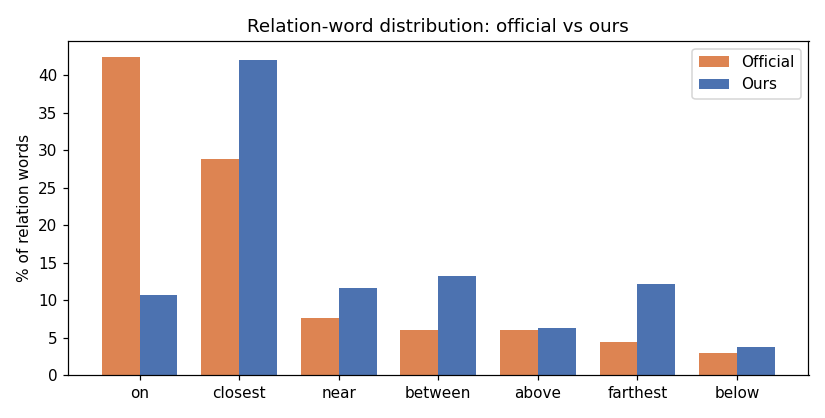
| relation | official | ours |
|---|---|---|
| on | 42.4% | 12.6% |
| closest | 28.8% | 42.2% |
| near | 7.6% | 10.9% |
| between | 6.1% | 12.3% |
| above | 6.1% | 6.3% |
| farthest | 4.5% | 11.2% |
| below | 3.0% | 4.5% |
Finding. After reweighting, closest leads and near/farthest are
minorities (matching the official ranking). The one gap that can't close is
on (12.6% vs 42.4%): humans default to "the bowl on the table", but the
VLA-3D scene graph holds only 819 on pairs vs 39,278 near — near is
computed for every nearby pair while on needs real physical support. closest
absorbs the primary-relation role that on can't fill. See the
relation-word reweight note in dataset_generator/README.md.
3. Target objects & answers
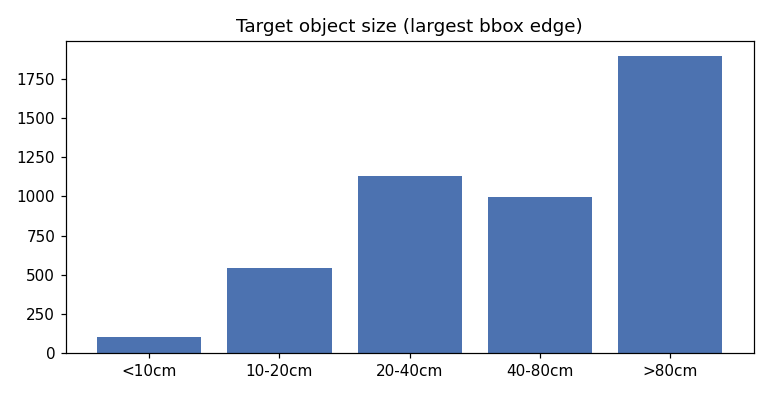
Target size (largest bbox edge): median ~56 cm, but ~14% are <20 cm (cup, candle, spoon, light switch…). The official set keeps its returnable targets distinctive/tabletop-scale-or-larger, so very small targets are a mild distribution risk — perception on the 360°/1920×640 camera resolves only a few pixels for an 8 cm object. (Filtering deferred.)
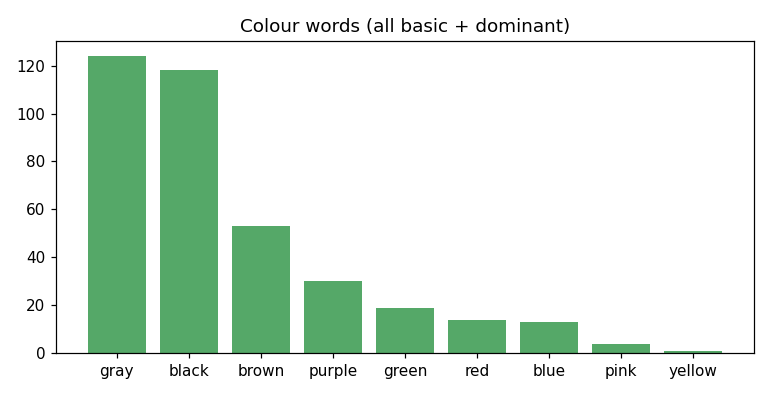
Colour modifiers are now all basic words at the object's dominant colour
(maroon→red, olive→green, etc.); minority-colour descriptors like the old
"blue book" (76% gray) are gone. Colour appears in ~7% of questions, matching
official.
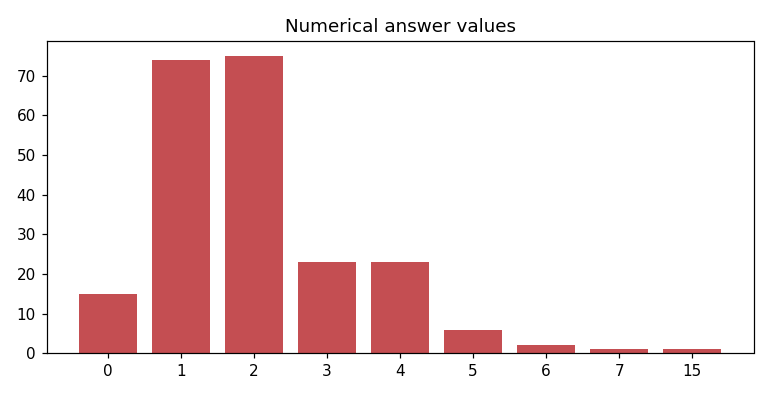
Numerical answers cluster at 1–2 (73 + 77 of 220) with a thin tail. Counts
of 1 are intentional (official "How many red pillows are on the sofa?" = 1). The
0 slice (15) is the refusal case ("How many pianos are there in the
room?") — deliberately balanced by an equal-phrasing totals slice (~30,
answers ≥1) so the "…in the room?" wording doesn't become a "⇒ 0" shortcut (0 is
33% of that phrasing, not 100%).
4. Scene coverage
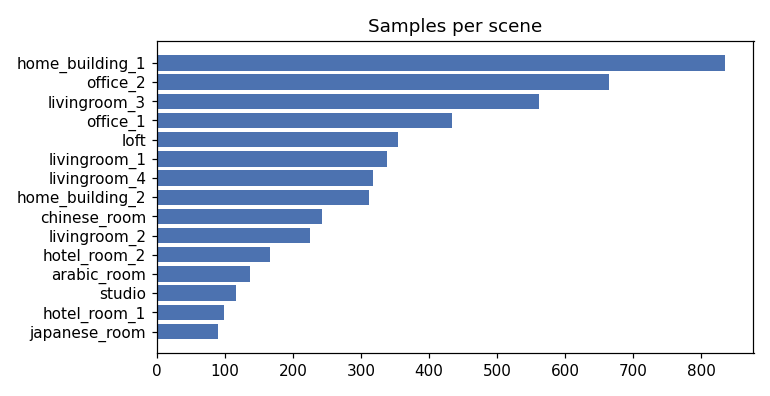
Samples are uneven across scenes — the multi-room home_building_1 (867) and
the dense office_2 (662) dominate; small single rooms like japanese_room
(102) contribute least. This tracks each scene's object/relation density. For
train/val/test, split by scene (group K-fold) so generalisation to unseen
scenes is measured honestly.
5. Phrasing features (object_reference)
| feature | official | ours |
|---|---|---|
| compositional (≥2 relations) | 57% | 28% |
| colour modifier | 7% | 7% |
| indefinite "a X" anchor | 13% | ~11% |
| omit-"Find" ("The X …") | 10% | 10% |
| ordinal ("second closest") | 0% | 0% |
compositional is below target — a trade-off of the relation reweight
(compositional questions are nested, and nested supply is near/farthest,
which we capped). VLA-3D can't be both 57%-compositional and on/closest-heavy.
6. Data problems found & fixed (the interesting part)
Each problem below was found by inspecting individual samples in the 3D visualizer, quantified across the corpus, then gated or reweighted out:
| # | problem | example | before → after |
|---|---|---|---|
| 1 | Redundant constraint — target class already unique in view, so the spatial relation does nothing | "Find the dvd beside the big chair" (only 1 dvd) | 37% → 0% |
| 2 | Relation-word skew — supply-driven near/farthest heavy, unlike the on/closest-led official set |
corpus was 29% near + 29% farthest |
reweighted: closest leads, near/farthest minority |
| 3 | Tied superlative — closest/farthest candidates stacked / equidistant → no determinate answer |
"the file nearest the plant" (two files at the same x,y) | 14% → 1.4% |
| 4 | Distance through a wall — straight-line ≠ navigable proximity | "the cabinet closest to the fire alarm" (glass partition between) | 23% → 0% |
| 5 | Weak / technical colour — minority colour, or VLA-3D's palette vs the official basic words | "the blue book" (76% gray); maroon mapped to red |
37% → 0% |
| 6 | "in the room ⇒ 0" shortcut — refusals (N5, answer 0) shared a phrasing with nothing positive | every "…in the room?" was 0 | balanced with N4 totals → 0 is 33% of that phrasing, not 100% |
Problems 1, 3, 4, 5 are logical defects (the sample is wrong or unanswerable); 2 and 6 are training-bias issues (the sample is valid but the distribution would teach a wrong cue). All were fixed in the generators, not by hand-editing the data.
A code review surfaced three more cross-generator consistency problems,
since closed: the single-layer and nested generators each applied the gates
independently, so (a) near was enforced as a strict closest superlative in
the single-layer half but as a 1.5 m-radius relation in the nested half — two
definitions of the same word; (b) object labels used VLA-3D's normalized class
("television") in one half and raw_label ("tv") in the other, putting both words
for the same object in the merged corpus; (c) the wall-between and colour gates
ran on only one generator. All three are now resolved by sharing the gates and
the label vocabulary (geometry.py, phrasing.py, raw_label everywhere).
The gates also shrank the corpus (a closest-led, defect-free corpus is
supply-limited to ~5k vs an earlier 12k that was near/farthest-heavy and
included these defects).
7. Takeaways
- Well-aligned: relation ranking, colour 7%, omit-Find 10%, zero ordinals, and the four logical-defect classes gated to ~0.
- Supply-capped (documented, not bugs):
on(12.6% vs 42%) and compositional (28% vs 57%) — VLA-3D's geometry can't supply more without re-introducingnear/farthestskew or duplicating the ~84 usableonanchors. - Open:
instruction_followingnot generated (needs official forbidden-zone labels); ~14% very small targets left in; numerical supply-capped at ~220.
Charts: docs/eda_assets/*.png, regenerated by
uv run python dataset_generator/eda_report.py (run after
dataset_generator/regen.sh).